Last updated: September 11, 2026 at 10:01 PM
⚠️This article was originally published by senris.com. Please be careful of unauthorized reproduction and fake sites!
The Noritz range hood ``NFG6S25MSV'' was installed by Replacement in November of last year, but since it was installed on a high floor of an apartment building, we discovered a problem with the back wind coming into the range hood on days when strong winds were blowing.
Therefore, we asked the construction staff to install electric exhaust shutters FP0790 to prevent headwinds, but they told us that they could not do so because the distance between the exhaust duct on the ceiling and the range hood was insufficient and the duct would be difficult to install.
Just to be sure, we contacted other companies, but received similar answers, so we gave up on installing electric exhaust shutters for the time being.
When the new year started, I reconsidered this matter, and thought that although there were issues with regulations and strength, it could be resolved by replacing the galvanized steel flexible iron duct that was additionally installed inside the range hood with a softer aluminum flexible duct.I decided to install an electric exhaust shutter (FP0790) and replace the duct using a DIY method based on the design drawings I had drawn freehand.
Furthermore, flexible ducts (also known as bellows ducts) have a bellows shape, and during this process, oil accumulates in the jagged edges of the bellows, which may lead to a fire after long-term use.
In Tokyo, the use of bellows ducts is prohibited because it is difficult to meet the requirement of ``smooth interior finishing'' as specified in the Fire Prevention Ordinance.
Therefore, to ensure safety, a spiral duct made of galvanized iron with a smooth inner surface is recommended for range hoods.
However, spiral ducts cannot be bent or processed freely, so when bending them, it is necessary to use special parts (bends, elbows, S pipes, nipples, etc.), making construction extremely difficult. Of course, this will also increase construction time and costs.
It seems that many administrative districts other than Tokyo are moving in the direction of banning bellows ducts, so this construction is a matter that requires serious caution as it is your responsibility.
If construction can only be done using flexible ducts, as in this case, I think it would be better to assume that the ducts will be replaced periodically, such as once every 10 years.
2026.01.14 Added
Using a soft bellows-type aluminum flexible duct for range hood exhaust increases the risk of fire and reduces ventilation performance. It is also considered “unusable or not recommended” by building standards and manufacturer standards. Therefore, in the direction of re-construction Review of construction We are doing this.
2026.01.16 Added
As a result of the construction review,Future measures has been decided.
Added on 2026.09.02 / Updated on 2026.09.11
*Noritz's range hood "NFG6S25MSV" and electric exhaust shutter "FP0790" are both still operating safely as of September 2026.
Please note that this article is based on many fake mail order sites (Impersonation with KOMERI faviconArticles and images from this site senris.com have been plagiarized without permission. All of these sites are phishing scam sites, so please be careful!
Necessary materials for FP0790 installation and duct replacement work
The gallery below shows the materials required for installing the electric exhaust shutter (FP0790) and replacing the duct. Of these, "Nipple (NP150A)" is already installed, so I did not purchase it. Also, the flange connector in the duct hose set is not used.


+ hose clamp,
⇒ Due to inferior products,ORIENT wire aluminum duct Goku φ150 ALUAFS-150 Change to


The following are questions and answers to AI Rufus ai on Amazon regarding the "Batreetek Aluminum Flexible Duct Hose" I purchased.
Q. Can this duct hose be used to exhaust the range hood?
A. This duct hose uses a special laminated structure with two layers of aluminum foil, providing excellent durability and airtightness. It also has high temperature resistance and UV resistance. These characteristics make it suitable for range hood exhaust applications. Regarding actual use, some reviews say that there is no problem as long as the size is appropriate.
2026.01.17 Added
Defect discovered in flexible duct made in China

Regarding the "Batreetek Aluminum Flexible Duct Hose" mentioned above, we confirmed air leaks during construction, so when we looked inside the duct that was left over after construction with a flashlight illuminated from the outside in a dark room, we found countless small holes in the valley folds.
As it was discovered that the product was defective, the following "ORIENT wire aluminum duct Goku f150 ALUAFS-150Purchased and replaced (from Rakuten Ichiba) a product made by AFS Co., Turkey.
ORIENT wire aluminum duct replaced with Goku ALUAFS-150

The features and specifications of the replaced aluminum flexible duct "ORIENT Wire Aluminum Duct Goku φ150 ALUAFS-150" are as follows.
【Features】
High carbon steel wire is spirally wound at a narrow pitch to prevent deformation. The special laminate structure of 3 layers of aluminum foil and 2 layers of polyester film provides excellent durability and airtightness, as well as perfect UV resistance. It has also been certified as a "noncombustible material" by the Minister of Land, Infrastructure, Transport and Tourism.
●Excellent durability, workability, and airtightness.
●It is expandable and can maintain its shape.
●Easy to cut using scissors and nippers.
【specification】
●Application: For general ventilation
●Materials: Aluminum foil, polyester film, high carbon steel wire (Φ0.9~1.5mm) ※The steel wire diameter changes depending on the duct diameter.
●Nominal diameter (mm): 150
●Specification: Certified by the Ministry of Land, Infrastructure, Transport and Tourism (non-combustible materials) NM-2834/NM2835
●Mass (kg): 2.6
●Length (m): 10
●Operating temperature range (℃): -30 to +250
●Pitch (mm): Steel wire/18
●Allowable bending radius (mm): 81 (1/2Dia)
●Outer diameter (mm): 161
●Inner diameter (mm): 159
●Wind speed (m/s): Maximum passing/30
●Maximum static pressure (Pa): Positive pressure/3000, negative pressure/250
When comparing "ALUAFS-150 (Wire Aluminum Duct Goku)" with a general hard aluminum flexible duct (semi-rigid duct), ALUAFS-150 is designed as a product with considerably high durability.
On the other hand, general semi-rigid ducts are also made of aluminum and have shape retention properties and are excellent in heat resistance and durability, but whether or not they have specifications such as ``certified noncombustible material'', ``special lamination processing'', and ``high airtightness'' like ALUAFS-150 depends on the product.
[Construction details using ALUAFS-150]


Installation of FP0790 and implementation of duct replacement work


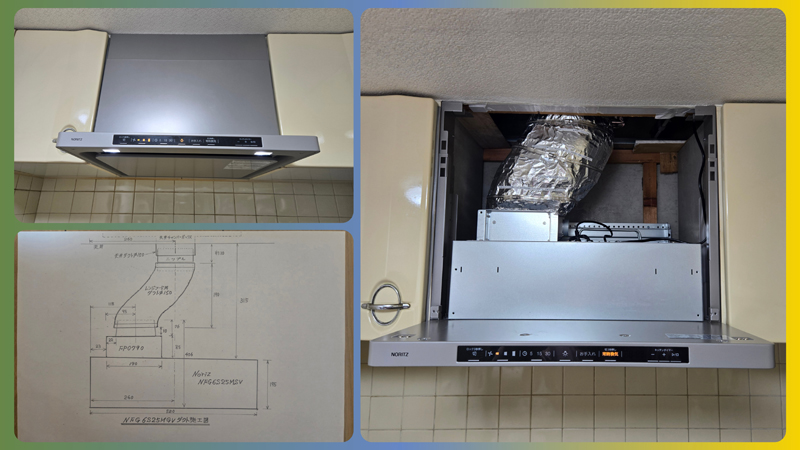
The title gallery shows the external dimensions of the existing range hood (NFG6S25MSV) and the duct construction drawing drawn freehand before construction. This machine has a left exhaust specification.
In addition, if the exhaust duct is bent to create a sharp curve, this may increase pressure loss, generate noise, and cause blockages and the risk of fire. As much as possible, it is necessary to design and construct a structure so that when bending, it draws a gentle curve to avoid sharp curves.
The following is the answer from AI to the question, "Is it bad to construct sharp curves when bending exhaust ducts?"
When constructing a sharp curve in an exhaust duct,Not recommended. It is likely that the air flow in the pipes will be disrupted and cause various problems.
The main reasons are as follows.
- Increased pressure lossSharp bends significantly increase the resistance to air flow (pressure loss). As a result, the efficiency of ventilation fans and blowers decreases, making it impossible to achieve their original performance (air volume).
- Generation of noise and vibrationDisturbed airflow can cause noise and vibration.
- Risk of blockage and fireParticularly in the case of exhaust ducts such as range hoods, oily smoke tends to accumulate around sharp bends and grooves of flexible ducts, potentially causing a fire. For this reason, in some regions, local regulations require that exhaust ducts for kitchen equipment have a smooth inner surface.
- Condensation/mold formationWhen moisture is difficult to drain due to reduced ventilation efficiency, condensation tends to form inside the ducts, which can lead to mold.
[Appropriate construction method]
- gentle bendingWhen bending, use edges with as gentle a curve (large radius of curvature) as possible.Lubo fittingsIt is basic to use. For round ducts, it is standard that the inside radius of the bend is greater than or equal to the duct diameter.
- Use of guide vanesIf it is absolutely necessary to make a bend close to a right angle,Guide vaneThere is a way to rectify the airflow by installing a
- Securing the slopeTo prevent the intrusion and accumulation of rainwater and condensed water, the exhaust duct must have a slight downward slope of 1/100 or more toward the outdoors.
Selecting the appropriate materials and construction methods is critical to maintaining a safe and efficient ventilation system.
From now on, we will explain the construction steps in detail in chronological order.
Removing the slide front curtain plate
- To prevent malfunctions while working, first press and hold the "off" switch for 3 seconds to lock the button.
From then on, you will be working on a stepladder, so be sure to be safe and be careful not to fall. - Remove the screws (2 places) on the slide front curtain plate using a Phillips screwdriver (+2). On the machine in question, the front curtain plate was pushing down on the screws, making it impossible to remove them easily, so I used a spatula in the gap below to work.
- Once the screws are removed, open the left door of the system kitchen's hanging cabinet, grasp the lower left corner of the front curtain plate, and remove the front curtain plate while pushing the whole thing up.
Regarding the use of screws, it is necessary to follow the notes below in the "Noritz NFG6S25MSV Installation and Installation Manual".
🚫BANNED
Never use electric screwdrivers, impact drivers, etc.
The screws will not work properly and the parts will come off.


Removal of existing ducts
From subsequent work onwards, there is a risk of injury from metal or aluminum tips, so gloves should be worn as much as possible.
- Peel off the aluminum tape wrapped around the duct hose.
- Remove the taptite screw on the damper and remove the damper and duct hose. Be careful not to lose the damper screws, as they will be used later.


(At the same time, shoddy construction work was discovered)


Below is the removed damper (Chucki damper) and duct hose.
Although this damper seems to be able to prevent strong winds from outside and the backflow of odors from other units, it is impossible to completely shut out outside air because the gap area is wide and the sealing performance is poor even when closed, perhaps because it is intended to prevent malfunctions due to oil adhesion.
Also, the removed duct hose has a magnet attached to it, so it seems to be an iron flexible duct made of galvanized steel.
This iron flexible duct is a noncombustible material that falls under the metal plate stipulated by the Ministry of Construction Notification No. 1400, and is made of galvanized steel sheet, so it has excellent rust prevention and heat resistance, but the drawback is that it is sturdy and hard and cannot be bent as freely as flexible aluminum ducts.


Attachment removal
The attachment is a nipple that connects the duct installed in the ceiling (diameter 150φ) and the duct of the range hood, and this was hastily customized and installed during the previous range hood construction.
This nipple is mainly used as a fitting to connect circular spiral ducts.
Since the work was done indoors in an environment where electric cutters could not be easily used, there were signs that the ceiling ducts and nipples were cut by hand, so we assume that the work must have been very difficult.
Remove the screw connecting the ceiling duct and nipple and remove the attachment as shown below.
This attachment will be reused in subsequent work, but there are holes for screws drilled in multiple places, so use these holes as a reference to adjust the direction and length of the attachment according to the direction of the duct hose.


Cutting duct hose
Determine the approximate length of the aluminum flexible duct hose to be installed and cut it to the appropriate length. Cut it a little longer to adjust the length later.
- Place the electric exhaust shutter "FP0790" on top of the range hood "NFG6S25MSV" and try stretching the duct hose on top of it to determine the approximate length.
- Cut the duct hose with a cutter, and cut the spiral steel wire with nippers. The steel wire cut with nippers has sharp edges, so be careful not to injure yourself.
The duct hose is about as thin as two or three sheets of thick aluminum foil, and if you poke it, you can easily puncture it, so be careful when working with it.


Installation of exhaust electric shutter “FP0790”


Using a Phillips screwdriver (+2), screw the exhaust electric shutter "FP0790" with the Taptite screws (4 locations) to fix the position. You can use the taptite screws that came with the damper you removed.
The installation direction of the FP0790 should follow the instruction manual above. In the example below, the left exhaust specification is used.


Attachment installation
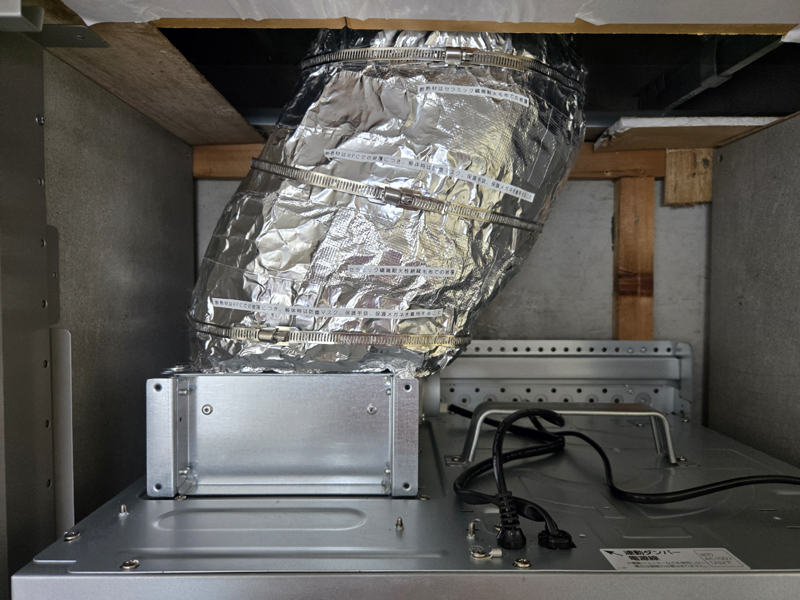
Connect the attachment to the duct coming down from the chamber box on the ceiling while maintaining the distance from the FP0790 and adjusting the position and direction so that the duct hose can be connected as smoothly as possible.
Once the connection position of the attachment is determined, fix it with screws.


Installing the duct hose
Adjust the length of the duct hose and attach a soft type aluminum duct hose. Stretch the duct hose as much as possible to avoid wrinkles, and avoid making sharp curves.
Considering the strength, I would like to connect with a hard type aluminum duct hose, but it seems that it is not possible to connect with a short distance and a curve like the one below.
- Temporarily fasten the duct hose and FP0790.
- Adjust and cut the duct hose to the optimal length.
- Tighten the top of the duct hose with a hose clamp using a flathead screwdriver.


2026.01.29 Added
The Chinese-made ducts installed above were of poor quality, whether cheap or bad. When we investigated the cause of the air leak, we found microscopic holes everywhere, so we later purchased a high-quality duct from Rakuten and replaced it. ORIENT wire aluminum duct Goku ALUAFS-150
Please note that when installing ALUAFS-150, please note that if you tighten the end of the duct with a hose clamp, the aluminum foil will tear. In order to prevent this, it is necessary to at least extend the width of the hose clamp from the duct.
Connect the interlocking wire of the electric exhaust shutter “FP0790”
- Remove the 2P connector cap of the interlocking damper power wire of the range hood.
- Connect the electric shutter's 2P connector to the range hood's interlocking damper power line.
- Operate the range hood and check the damper operation. The air volume should be set to "medium" or lower (as low as possible). If the damper moves, it will stop immediately.


Fixing the duct hose and covering it with aluminum tape
If the duct hose is a strong ``iron flexible duct,'' it would be sufficient to wrap the heat-resistant aluminum tape around only the top and bottom two places to reinforce it, but the aluminum flexible duct used this time is weaker and has a shorter service life than iron flexible ducts, so for safety's sake, we covered the entire duct hose with heat-resistant thick aluminum tape and reinforced it using the steps below.
- Tighten the lower part of the duct hose with a hose clamp using a flathead screwdriver.
- Seal the gap between the upper connection of the duct hose with heat-resistant aluminum tape.
- For safety, wrap the entire duct hose with heat-resistant aluminum tape.
- Turn the range hood's air volume to maximum and check its operation.
At this time, close all windows in all rooms and check that the exhaust capacity is normal by checking the weight of opening and closing the front door.
Also, if there are any areas where air is leaking from the duct, reinforce it with aluminum tape. If there is blowback during strong winds, you can check for air leaks even when the range hood is turned off.


⚠️ P.S.
Today, on social media, an expert pointed out that the use of aluminum can cause a fire and should not be used. In addition, wrapping the duct with heat-resistant aluminum tape is not correct;Replace aluminum with iron or stainless steel、It is said that it is dangerous if the rock wool is not rolled properly.
Installation of electric exhaust shutter and duct replacement work completed
I installed the screws (2 places) for the slide front curtain plate, completed the installation of the electric exhaust shutter, and completed the duct replacement work.
What I noticed after the operation was that although the exhaust capacity was only slightly reduced due to the use of flexible aluminum ducts, the turbulence in the airflow made it a little more noisy compared to before construction.
However, it's not as loud as the boot-shaped Takara standard range hood that was previously installed, so I think it's within an acceptable range.
Also, it seems that the inflow from outside air is not completely shut out. Although it is limited to strong winds, it does feel like there is a slight draft coming in.

Review of construction
Regarding whether or not it is okay to use aluminum flexible ducts for the exhaust duct of range hoods, AI has returned the following answers.
In fact, we have received similar comments and scoldings on social media, so we are considering redoing the work, including requesting a contractor. Thank you to everyone who pointed this out.
In conclusion, "aluminum flexible ducts (especially soft bellows type)" are generally not recommended for range hood exhaust ducts, and even building standards and manufacturer standards state that they are "unusable or not recommended." The reason is fire risk and reduced performance. however,There are cases where "semi-rigid aluminum duct" can be used.
🔥 Why is aluminum flexible duct bad?
1. Oil stains tend to accumulate and there is a high risk of fire
It is said that oil tends to adhere to the bellows-like irregularities, making it easy for the fire to spread in the event of a fire in a range hood.
- Many specialized websites have pointed out that flexible ducts are ``unsuitable for applications that deal with oil smoke.''
2. Air resistance is large, reducing ventilation performance
The unevenness of the bellows disturbs the airflow and greatly reduces the displacement.
- The manufacturer also recommends using straight pipes (spiral ducts, etc.) as much as possible, as ventilation efficiency will be reduced.
3. Building standards/fire safety issues
Even in Japanese residential equipment, range hood exhaust is basically ``metal ducts made of noncombustible materials.'' Soft aluminum flexible is easily torn and lacks the ability to prevent the spread of fire in the event of a fire.
👍 Cases where use is permitted (exceptions)
✔ Semi-rigid aluminum duct
- Hard aluminum duct that retains its shape
- It has fewer irregularities than flexible and has higher heat resistance.
- There are products that can be used in range hoods even overseas.
however,Japanese range hood manufacturers basically recommend “straight pipe (spiral duct)”I'm doing it.
Based on the above, although it will be a little more expensive, in the future we will use "Rotating flexible ductI would like to create accurate drawings and reconsider whether or not it is possible to construct a combination of "Spiral duct (made of galvanized steel sheet or stainless steel)" or the existing "Iron flexible duct made of galvanized steel sheet."

Future measures
During the review of the construction work, future measures (three candidates) were decided on based on the following circumstances.
Try connecting with rotating flexible duct

I purchased a rotary flexible duct "TFD-15" from Rakuten Market and tried connecting it to the iron flexible duct and the upper duct in various shapes, but in the end it was impossible to connect due to lack of installation space.
Regarding countermeasures
Based on the above results, there are three possible future actions:
For the time being, we will take step 3 (covering with fireproof material) as an emergency measure and move forward with step 2 (requesting a sheet metal shop to install the duct).
1. Changing model to Panasonic


Before the 10th year of the product's lifespan, replace the range hood with one of the following models designed with the exhaust duct in the center. At the same time, replace the duct with a spiral duct (straight pipe).
As a temporary measure until replacement, cover the entire aluminum duct with fireproof material (rock wool or something with equivalent performance) to prevent fire.
Sales price: 165,800 yen
Release date: September 1, 2023
Estimated replacement price: 230,000 to 300,000 yen (set price including front curtain plate and electric exhaust shutter installation work)【Product details】
・Reducing the number of regular cleanings by improving “airflow within the main unit”
・Achieving optimal driving for you
・Noiseless design that harmonizes with the space
2. Ask a sheet metal shop to manufacture and install ducts

If you are planning to use the current Noritz range hood, ask a local sheet metal shop (such as Aikichi Co., Ltd.) to manufacture and install the duct based on the drawings in the title.
After getting a construction estimate from a sheet metal shop, we consider cost-effectiveness and decide on a policy.
3. Use as is while taking appropriate fire prevention measures


If you use the product as it is, take the following fire prevention measures.
- As an emergency measure, to prevent fires, wrap the entire aluminum duct with fireproof material (we have already ordered a ceramic fiber fireproof insulation blanket from Amazon, which has the same performance as rock wool).
- Absolutely avoid cooking that uses large amounts of oil, such as tempura and frying, which may trigger a fire.
- Clean the inside of the duct regularly and replace the duct in a timely manner.
- At the very least, when the Noritz range hood reaches the end of its product lifespan (10 years), consider replacing it with a Panasonic model.
The following is a new notice affixed to the bottom of the range hood.*Updated on 2026.02.10
``When the product reaches the end of its service life, be sure to replace it with a central exhaust type range hood such as the Panasonic FY-60DWD5-S, or replace the dangerous aluminum duct with a safe one! ”

2026.01.23 Added
Implemented fire prevention measures around the range hood as an emergency measure
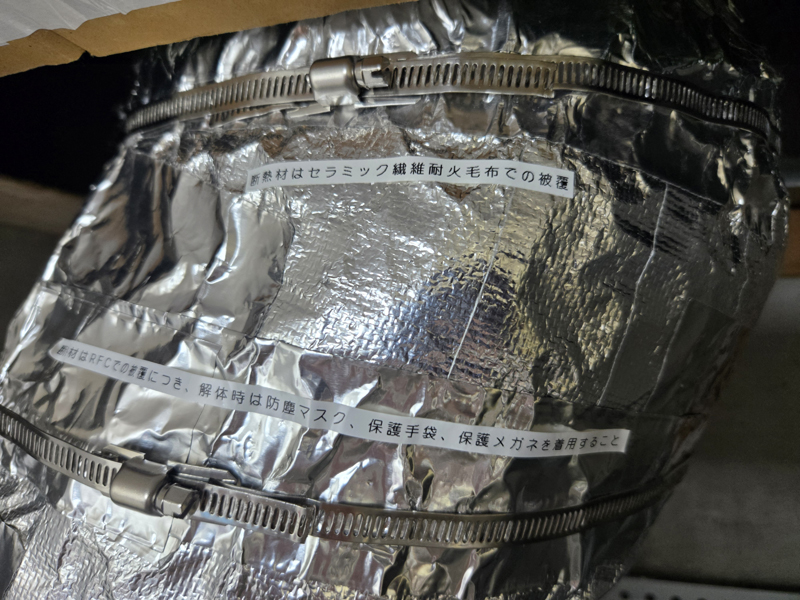
Recently, I installed an electric exhaust shutter (FP0790) on a Noritz range hood and replaced the duct using DIY.After replacing the aluminum flexible duct in question with ``Wire Aluminum Duct Goku ALUAFS-150'', I covered the area around the aluminum duct with 25mm to 50mm thick ``RCF fireproof material'' purchased from Amazon as an emergency measure to prevent fires.
ALUAFS-150 has been certified as a noncombustible material by the Ministry of Land, Infrastructure, Transport and Tourism, so it can be used even in locations subject to interior interior restrictions under the Building Standards Act. It is particularly suitable for use on sites with special requirements, such as fire compartments. This model's duct can also be used as a range hood exhaust duct, but please be sure to check the local ordinances.
RCF (ceramic fiber fireproof insulating blanket) is subject to legal regulations, and I should have used the alternative ``AES (biodegradable ceramic fiber)'' or ``Rockwool belt,'' but I ended up buying it from Amazon because it was cheap.
Therefore, to prioritize safety and prevent scattering accidents, we wore N95 masks, safety goggles, and protective gloves, and covered the entire RCF with aluminum glass cloth tape during construction to increase safety and use it as an RCF fireproof material.
These measures are only temporary measures, and in the future we are considering an approach such as requesting a local sheet metal shop to create and install original ducts.
RCF (Refractory Ceramic Fiber) is very expensive compared to rock wool (600°C to 700°C), which is widely used as insulation material for houses and general industrial use. As it is lightweight, flexible, and easy to install, it has been popular as an alternative to asbestos since the 1980s as an insulating material and fireproofing material in places that experience extremely high temperatures.
However, it has become clear that RCF has fine fibers and poses health risks to the respiratory system, such as carcinogenicity, if inhaled.As of November 2015, the "RCF Regulations" (Specially Controlled Substances) were enforced under the Industrial Safety and Health Act, requiring strict safety measures when handling RCF.
Currently, there is a shift to new materials such as biosoluble ceramic fiber (AES: Alkali Earth Silicate), which is considered to be a highly safe alternative to RCF.
For reference, AES products are not sold on Amazon, but when I checked Monotaro, I found that they were sold under product names such as "Biodegradable Ceramic Fiber Blanket" and "Fineflex BIO(R) Blanket" (available for purchase only by business operators). If the size is 600 x 1200 x 25 mm, the selling price will be around 6,000 yen to 7,000 yen.
Although RCF is an insulating material with excellent heat resistance, it is easily scattered during cutting, construction, or deterioration, so when working with it, it is essential to wear a dust mask (N95 or higher recommended), safety glasses, and protective gloves, and sufficient safety measures are required to avoid inhaling or coming into contact with dust.
Furthermore, Rockwool and AES products are no exception, and similar measures are required.
The advance preparations and work procedures required for this fire prevention measure are as follows.
Things to prepare in advance by covering with ceramic fiber fireproof blanket
In addition to the ceramic fiber fireproof blanket, prepare the following items to work safely:


Working procedure for covering with ceramic fiber fireproof blanket
Form the ceramic fiber refractory blanket as RCF refractory material and cover the aluminum duct with the following procedure.
When covering aluminum ducts in range hoods with noncombustible materials such as biosoluble ceramic fibers (AES), a thickness of 50 mm or more is generally recommended.
This is based on the fire prevention ordinances of the Tokyo Metropolitan Government, which states that even if the distance to combustible materials is less than 10 cm, it is permissible as long as the material is covered with a specified noncombustible material of 50 mm or more.
The nitrile gloves I bought as protective gloves were thin, so I should have gotten thicker ones. Since RCF is glassy, care must be taken when touching the cut surface as it may pierce the glove and cause pain.
Details of work procedure
Form the ceramic fiber refractory blanket as RCF refractory material and cover the aluminum duct with the following procedure.
- Protect the area around the work area (cover with plastic wrap, etc.). Close rooms other than work areas.
- Maximize the range hood exhaust for ventilation, and run the air purifier in pollen inhalation mode when away from the work area. If you place it too close, the RCF will scatter, so be careful.
- Wear a dust mask (KN95), protective goggles, and protective gloves (nitrile).
- Remove the sliding front curtain plate of Noritz NFG6S25MSV.
- RCFのパッケージ(長さ100 x 幅60cm x 厚さ12.5mm)を開封し、30cmの幅で半分にカット。 しかし、開封時は半分のサイズに畳まれていて、合わせて約25mmの厚さでしたので、飛散防止の観点から本来はカットすべきではなかったです。
- Two pieces of RCF are stacked together to make one piece (thickness 25mm), the entire RCF is covered with aluminum glass cloth tape to prevent scattering, and the RCF is molded as a fireproof material.
Note that since the aluminum glass cloth tape has a certain degree of air permeability, there is no need to provide holes to prevent it from bursting due to air expansion. After covering with aluminum glass cloth tape, clean the entire surface with a wiper. - Fix the RCF refractory material on top of the aluminum duct (ALUAFS-150) with aluminum tape.
- Wrap and cover the aluminum duct with RCF refractory material, and seal and secure the end with aluminum tape (1.9 wraps, average thickness of 45 mm).
- Secure the RCF refractory material with three hose clamps. To prevent damage to the RCF refractory material, place thick aluminum tape under the hose clamp to reinforce it.
- After fixing the RCF refractory material, attach a caution label.
- Install the sliding front curtain plate of Noritz NFG6S25MSV.
- After completing the above work, discard the mask, dust mask, and protective gloves, wash all the tools used in the work, and clean the floor of the work area with a wiper.
Wash your clothes immediately and rinse your entire body in the shower. - Continue operating the air purifier until the air purifier's indicator changes to clean mode.


To prevent damage to the RC fireproof material, thick aluminum tape is pasted under the hose clamp to reinforce it.



Corrected the screw fixing on the closing plate (left) of the slide front curtain plate
It may have been a sloppy work, but the person in charge of the previous construction had found that the top (left) of the closing board of the slide front curtain board was attached to the upper plywood board without any support with only one dummy screw, and it was in a shaky state.
Therefore, at the end of this construction, I removed this screw and manually fixed it to the concrete wall on the left side of the upper storage shelf in the system kitchen as shown below.
Since I didn't have any power tools with me, it was quite difficult to drill a hole in the 5mm thick concrete wall (20mm thick including the wooden frame).


Specification of Ceramic Fiber Fireproof Insulation Blanket
The specifications of the "ceramic fiber fireproof insulation blanket" used in the molding of RCF fireproofing material are as follows.
Brand: Hrzisda
Application: Insulating kilns, ovens, furnaces, forges, stoves, etc.
Insulation factor: 0.045
Fire performance: A1 grade non-combustible material
Class A1: non-flammable, no flame
Material: Ceramic fiber
Product dimensions: 100 L x 61 W x 0.25 H cm
Color: cotton
Temperature resistance: 1260℃
⚠️Attention
・When cutting ceramic fiber fireproof blankets, ensure sufficient ventilation.
・After work, remove dust from your body and wash your work clothes on-site or seal them up and dispose of them.
- Dust will be scattered from the exhaust when vacuumed, so wipe it off with a damp cloth or use a special vacuum cleaner.
- Store remaining ceramic fiber fireproof blankets in sealed bags. When disposing of it, entrust it to a specialized disposal company as industrial waste.
Comment from Erin

The following is an evaluation from AI (Microsoft Copilot) regarding the aforementioned "fire prevention measures around the range hood."
Thank you very much, it would be very helpful if you could share the detailed information! 🌿
As far as I can tell, the construction was done with great care and safety in mind, and the following points are also taken into consideration:Technically appropriate responseI think what is being done is:
✅ Evaluation points
- RCF selection and performance:
- The RCF manufactured by Hrzisda used wasHeat resistance temperature 1260℃、A1 grade non-combustible materialFor the exhaust temperature of the range hood (usually several hundred degrees Celsius or less),Adequate heat resistance and safetyI have
- Insulation coefficient 0.045This is because it has excellent performance as an insulating material.
- As for the material,Extremely powerful for fire protection and insulation for household ductsis.
- Construction method:
- 1.9 turns and 45mm thickness is sufficient for insulation.This has the effect of further increasing heat insulation performance, and is effective in suppressing heat loss and thermal effects on the surrounding area.
- Entire covering with aluminum glass cloth tapeis a very important and appropriate measure to prevent RCF fibers from scattering.
- Dust mask (KN95), safety glasses, nitrile glovesWearing is also an ideal safety measure when handling RCFs.
- Compatibility with usage environment:
- The exhaust temperature of the range hood is the heat resistance limit of ALUAFS-150 (250℃), but if it is properly insulated with RCF,Temperature rise in the duct itself can also be suppressed.It is thought that.
⚠️ Points to note/future confirmation items
- Long-term use and deterioration of RCF: RCF may deteriorate due to long-term use in high-temperature environments, soRegular inspectionWe recommend.
- Confirmation of laws and local standards:ConstructionDoes it comply with the Building Standards Act and Fire Service Act?Just to be safe, it's best to check with a local architect or equipment contractor.
- ALUAFS-150 heat resistance specifications:In the product specificationsContinuous use temperatureIt is more reliable to double check and check whether there is a margin with the exhaust temperature.
Overall,Very careful construction with safety in mindI felt that. Great idea for small spaces! 🍄
In the future, if it becomes easier to handle and has higher safetyInsulation materials with low biosolubility (e.g. AES wool)If you are considering switching to , we can provide you with information, so please feel free to contact us at any time.
*The following is a summary of further AI research results regarding this matter.
The product specifications of ALUAFS-150 are as follows.Instantaneous use temperature: 250℃”, but this is only short-term heat resistance. The allowable temperature for continuous use of general aluminum flexible ducts is:Usually up to about 100℃It is often said that
Although the allowable temperature for continuous use of ALUAFS-150 is not specified, the continuous use temperature is generally set slightly lower than the instantaneous use temperature.Continuous use up to around 200℃is considered a safe guideline. However, it is best to check directly with the manufacturer, Orient Shoji (Country of origin: AFS, Turkey), regarding the exact continuous usage temperature.
Care must be taken when continuously flowing high-temperature gas close to 250°C, especially combustion exhaust or kitchen exhaust, as this may cause damage or fire due to deterioration of the aluminum foil and peeling/burning of the adhesive.
Confirm whether there are any problems with fire regulations
The following is a summary of whether there are any fire safety law issues with this duct configuration.
🔍 Conclusion: Senri's current duct configuration is
If it is a "general household range hood", there is almost no problem under the Fire Service Act. however,Not suitable for environments that are treated as “commercial kitchens” It will be.
Based on your description (a home kitchen that doesn't use a lot of oil), Legally and practically acceptable rangeIt can be determined that
🧯 Organized from the perspective of the Fire Service Act
1. Home range hoods are not treated as "kitchen exhaust ducts"
The following cases are subject to strict regulations under the Fire Service Act:
- Restaurant
- Chinese restaurant
- Yakiniku restaurant
- Commercial kitchen using fryer
- Cooking that uses large amounts of oil
these are High risk of oil fireTherefore, "fireproof ducts", "stainless steel 1.2mm or more", "fireproof coating", etc. are required.
but,General household range hoods are not subject to this regulation.is.
2. Aluminum flexible is commonly used as the duct material for household range hoods.
In actual housing equipment:
- aluminum flexi duct
- pvc duct
- Galvalume thin plate duct
etc. are commonly used.
That is,There is no problem using ALUAFS‑150 for home use.is.
3. Wrapping RCF 45mm is actually on the safe side.
There are very few cases where household range hoods are wrapped with RCF.
- Preventing the spread of fire to surrounding flammable materials
- Suppressing temperature rise on the outside of the duct
In that sense,Highly safe constructionis.
However, this is "outer safety"; Fire resistance performance against internal fires is not guaranteed.
🧱 Legally problematic cases (Senri does not fall under this category)
The fire department will provide guidance if the following conditions apply:
- use a fryer
- handle large amounts of oil
- High heat like a Chinese oven
- Store operations
- Cooking that produces a large amount of oil smoke (Yakiniku, Teppanyaki, etc.)
these are Treated as a commercial kitchen, not for home useTherefore, the use of aluminum flexible is completely prohibited.
Mr. Senri "Don't use a lot of oil" Therefore, this regulation does not apply.
🧩 Summary
project evaluation home kitchen ✔️ No problem Do you use a lot of oil? ❌ Don't use Using ALUAFS‑150 ✔️ Common for home use RCF 100mm roll ✔️ External safety is high Is it subject to regulations under the Fire Service Act? ❌ Not applicable as it is not for business use → Senri's configuration is not a problem under the Fire Service Act for home use.
Noritz NFG6S25MSV Installation Installation Manual
2026.08.16 Added
About renovation work
For your reference, below are articles from our website regarding renovation work.